Marketing expert Andy Franco shares his 12-part AI prompt chain, NotebookLM workflow, and strategy for using Claude and Perplexity to grow your business smarter.
Introduction
If you’ve ever felt like AI is just another shiny object pulling you away from what actually grows your business — you’re not alone. Most entrepreneurs are drowning in tools, tutorials, and FOMO, without a clear system for putting it all together.
That’s exactly why this conversation with Andy Franco hit differently.
Andy is a strategic marketing consultant with over 20 years of experience working with online coaches, course creators, and educators. He joined me on the AI Entrepreneurs Podcast to talk about something I think every entrepreneur needs to hear: how to use AI intentionally — not just obsessively.
Future-Proofing Your Business With AI
One of the most powerful ideas Andy shared was flipping the script on how we think about AI adoption. Instead of asking “what tools should I learn?” he recommends asking a better question: what’s working in my business right now — and how could AI disrupt it in the next six months?
His advice? Take that question directly to your favorite AI tool. Share your current business model, your revenue drivers, your workflow — and ask it to map out where disruption is most likely to hit. Then let AI help you build a plan to stay ahead.
This approach cuts through the noise. Instead of chasing every new release, you stay focused on protecting what’s already working and building systems that will hold up as things shift.
The 12-Part AI Prompt Chain for Ad Creative
Andy’s most tactical share of the episode was his 12-part prompt chain — a systematized process for building full ad creative using AI. Here’s how it works:
He starts by taking a full screenshot of a sales page and uploading it as a PDF. From there, he runs a series of sequential prompts — each one building on the last — that analyze the traffic type, define the target audience, map out potential objections, and generate ad copy variations for both static and video formats.
By the time you reach the final prompts, the AI has built a rich, layered understanding of the product and brand. The output isn’t generic — it’s grounded in the specific voice, audience, and offer of that campaign.
This is what separates AI-assisted marketing from AI-dependent marketing. The system is his. The AI just speeds up the execution.
Using NotebookLM to Capture Client Voice
One of the most underrated tools Andy mentioned is NotebookLM — Google’s AI-powered notebook that lets you upload source documents and have conversations with the content.
His workflow: pull in a client’s blog posts, podcast episodes, and other brand content. Let NotebookLM synthesize how that person speaks — their tone, their vocabulary, their audience assumptions. Then use that voice map to write ad copy that actually sounds like the client.
No lengthy intake interview required. The content does the work.
This is the kind of practical, repeatable system that transforms a one-off project into a scalable process — and it’s exactly the kind of AI workflow that saves real time without sacrificing authenticity.
Why Claude Is His Go-To LLM
Andy made a point that I’ve heard echoed more and more lately: Claude pushes back.
Unlike tools that just agree with whatever you feed them, Claude will flag when you’re overcomplicating something, suggest alternatives, and give you real input — not just polished output. For someone doing strategic marketing work, that kind of friction is actually valuable.
He’s also a fan of Claude Projects, which lets him build a dedicated resource library for each client — similar to the NotebookLM workflow, but integrated directly into his writing and strategy process.
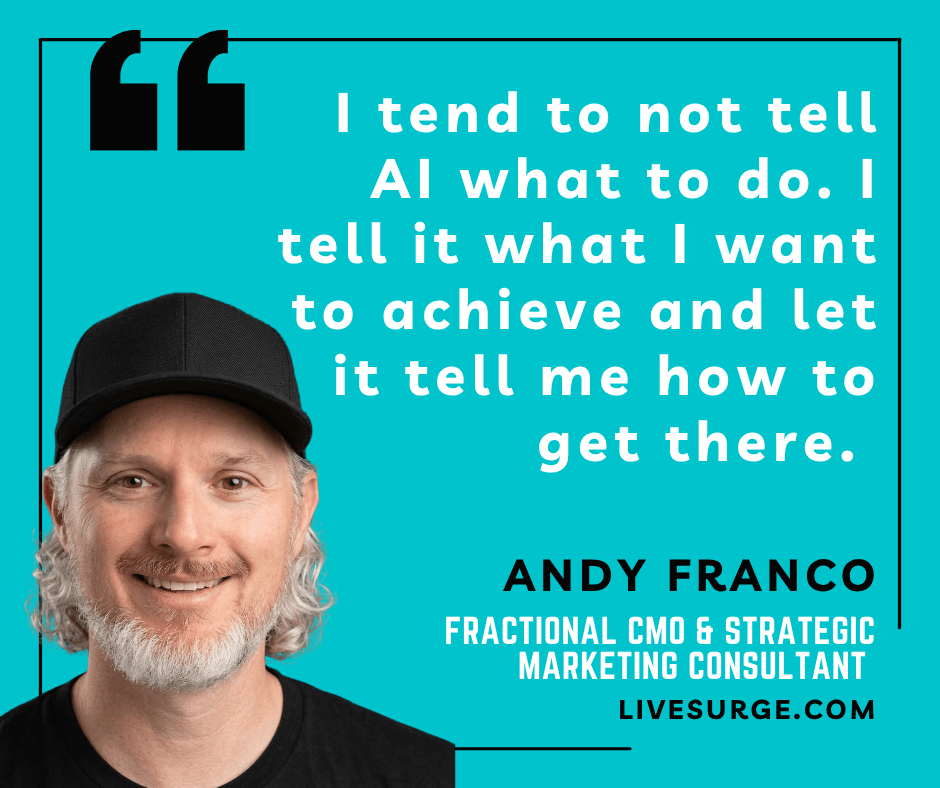
His advice for prompting? Don’t tell AI what to do. Tell it what you want to achieve — and let it show you how to get there.
Key Takeaways
- Ask AI to help you future-proof your business by identifying what’s most at risk in the next six months
- Build a repeatable prompt chain for ad creative so your process is systematized, not ad hoc
- Use NotebookLM to capture client voice from existing content before writing a single word of copy
- Claude’s tendency to push back makes it especially useful for strategic marketing work
- Ads work best when you already have an offer that’s converting organically — don’t use ads to test a broken funnel
- The goal isn’t to use every AI tool — it’s to use the right ones in a way that protects your time and amplifies your results
Conclusion
Andy Franco is proof that longevity in marketing comes from staying curious, staying systematic, and never getting too attached to any single tool or tactic. His approach to AI isn’t about chasing what’s new — it’s about building smarter, more sustainable systems that actually support the work.
If this resonated with you, go listen to the full episode of the AI Entrepreneurs Podcast wherever you get your shows.
And if you’re ready to build AI-powered systems in your own business — with real support and a community that gets it — come join us inside AI Amplified for Entrepreneurs at skool.com/ai-amplified-entrepreneur.

 AI Coaching with Angelina
Leave a comment